
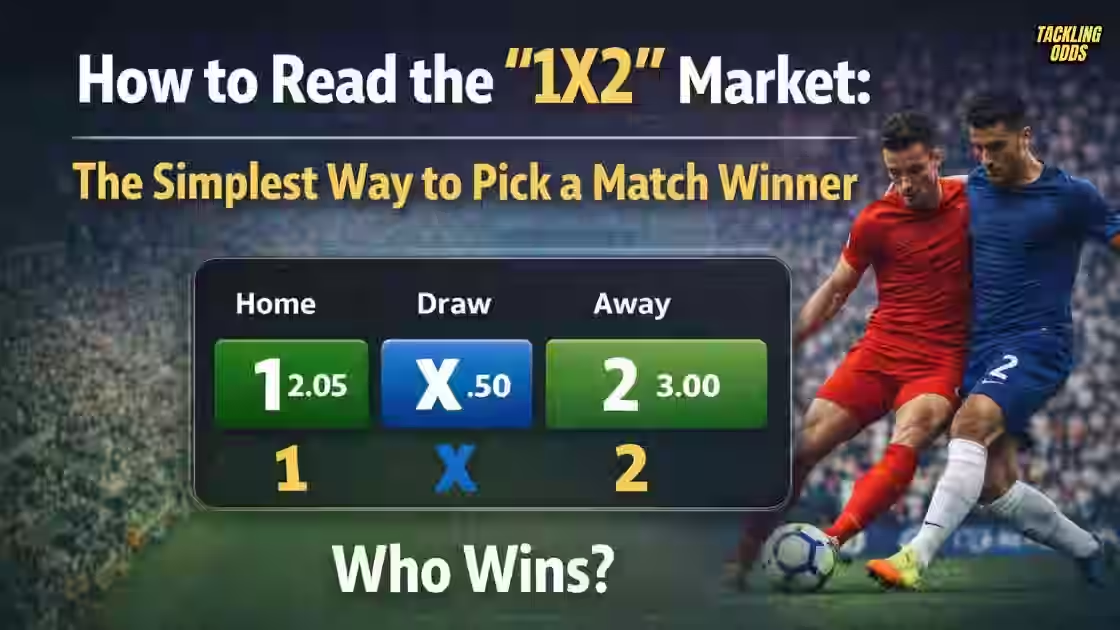
Understanding the betting markets can feel like trying to decode a foreign language, especially when you’re staring at a screen full of numbers, symbols, and abbreviations. But if you want to strip away the complexity and get to the heart of sports wagering, there is no better starting point than the 1X2 market.
Known as the “Match Result” or “Three-Way” market, 1X2 is the most popular way to bet on sports like football (soccer), cricket, and rugby. It is the bread and butter of the betting world because it mirrors the actual result of the game: Win, Lose, or Draw.
In this comprehensive guide, we’re going to break down exactly how to read the 1X2 market, the math behind the odds, and the strategic secrets to picking winners in 2026.
What Does 1X2 Mean? The Anatomy of the Bet
At its core, 1X2 is a shorthand system used by bookmakers to represent the three possible outcomes of a match that can end in a tie.
- 1 (Home Win): You are betting that the home team (the team listed first) will win the match.
- X (The Draw): You are betting that the match will end in a tie after regular time.
- 2 (Away Win): You are betting that the away team (the team listed second) will win the match.
Why is it called “1X2”?
The terminology dates back to the early days of European football pools. “1” was the first option on the coupon, “X” was the cross for a draw, and “2” was the second option. Even in the digital age of 2026, where apps have replaced paper slips, this notation remains the global standard.
The “Full-Time” Rule
One of the most important things for a beginner to understand is that 1X2 bets almost always apply to “Regular Time” only. In football, this means 90 minutes plus any injury time (stoppage time) added by the referee. If a cup match goes into Extra Time or a Penalty Shootout, those results do not count for your 1X2 bet. If the score is 1-1 at the 90-minute whistle, the “X” (Draw) is the winning selection, regardless of who wins in the shootout.
How to Read 1X2 Odds (And What They Tell You)
When you open a betting app like Bet365 or 1xBet, you’ll see three numbers next to a match. Let’s look at a hypothetical Premier League clash between Manchester City and Chelsea at the Etihad Stadium.
| Outcome | Selection | Odds |
| Manchester City | 1 | 1.45 |
| Draw | X | 4.50 |
| Chelsea | 2 | 7.00 |
1. Identifying the Favorite and the Underdog
The lower the number, the more likely the bookmaker thinks that outcome is to happen. In this case, Manchester City (1.45) are heavy favorites. Chelsea (7.00) are the underdogs.
2. Calculating Your Potential Payout
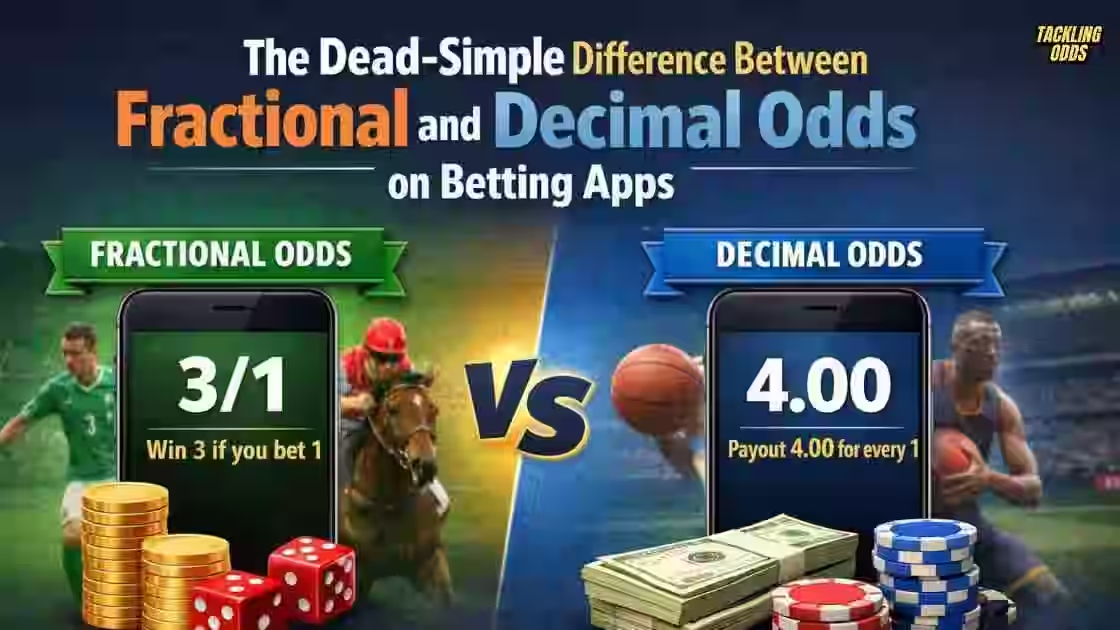
In 2026, most global bettors use Decimal Odds because the math is incredibly simple:
Stake × Odds = Total Return
If you bet 100 on Manchester City (1) at 1.45:
100 \times 1.45 = \145
(Your profit is 45, plus your original 100 stake).
If you feel lucky and bet 100 on Chelsea (2) to pull off an upset at 7.00:
100 \times 7.00 = \700
(Your profit is 600).
3. Understanding Implied Probability
Odds aren’t just about payouts; they are a reflection of the probability of an event. You can calculate the “Implied Probability” by dividing 1 by the decimal odds.
- Man City (1.45): 1 / 1.45 = 68.9\%
- Draw (4.50): 1 / 4.50 = 22.2\%
- Chelsea (7.00): 1 / 7.00 = 14.2\%
Pro Tip: If you add those percentages up, you’ll notice they equal 105.3%. That extra 5.3% is the “overround” or the “vig” it’s the bookmaker’s profit margin. To be a successful bettor, you need to find edges where your calculated probability is higher than the bookie’s implied probability.
Why the 1X2 Market is the Best for Beginners
While markets like “Asian Handicap” or “Over/Under 2.5 Goals” have their place, the 1X2 market is the gold standard for anyone starting out.
Simplicity and Clarity
There are no “half-goals” or complex spread calculations. You are simply picking who will win. This allows you to focus your energy on researching the sport rather than trying to understand the mechanics of the bet.
High Liquidity and Better Odds
Because the 1X2 market is the most heavily traded, bookmakers are forced to keep their margins low to stay competitive. You will often find the “truest” prices here compared to niche markets like “First Goalscorer” or “Number of Corners,” where the bookmaker’s margin can be much higher.
Perfect for Accumulators (Accas)
The 1X2 market is the foundation of the “Acca.” By combining four or five “Home Win” selections into one bet, you can turn small stakes into massive payouts. For example, four favorites at odds of 1.50 combined would give you total odds of 1.50 \times 1.50 \times 1.50 \times 1.50 = 5.06.
The 2026 Strategy: How to Pick Winners in the 1X2 Market
Gone are the days when you could just “bet on the big team” and expect to make money. Modern football is data-driven, and your betting should be too. Here is a blueprint for analyzing a 1X2 match-up.
1. The Power of Home Advantage (The “1”)
Even in the modern era of neutral venues and VAR, home advantage is real. In the 2025/2026 Premier League season, home teams won approximately 42% of matches.
- Travel Fatigue: Away teams often deal with travel schedules that disrupt sleep and recovery.
- Pitch Familiarity: Every pitch has slight variations in dimensions and grass type that favor the residents.
- Crowd Pressure: While referees try to be impartial, the “twelfth man” can influence 50/50 calls.
2. When to Back the Draw (The “X”)
The Draw is often the most overlooked value in the 1X2 market. Most casual fans want to see someone win, so they avoid the “X.” This often causes bookmakers to inflate the odds of a draw to attract action.
- Low-Scoring Leagues: In leagues like the French Ligue 1 or the Greek Super League, where goals are scarce, draws are statistically more frequent.
- The “Must Not Lose” Scenario: Toward the end of a season, if two teams in a relegation battle face each other, both might be content with a point. A 0-0 or 1-1 becomes highly probable.
3. Spotting the Value Underdog (The “2”)
Betting on the away win is where the “sharp” money often sits. To find value here, look for tactical mismatches.
- Counter-Attacking Specialists: A team like 2026 Manchester United or Aston Villa might struggle when they have to break down a “low block” at home, but they excel when they can sit back and counter-attack away from home.
- Injury Crisis: If the home team’s star center-back and goalkeeper are out, the “1” odds might still be low based on reputation, but the “2” is where the real value lies.
4 Common Mistakes to Avoid in 1X2 Betting
Even the most seasoned punters fall into these traps. If you can avoid these four errors, you’ll already be ahead of 90% of the betting public.
1. Chasing “Big Name” Bias
Just because a team is famous doesn’t mean they are a good bet. Teams like Real Madrid or Bayern Munich often have “inflated” odds. Because so many people bet on them regardless of form, the bookmakers drop the odds to 1.15 or 1.20. The risk-to-reward ratio in these cases is usually terrible.
2. Ignoring Team News and Lineups
In 2026, manager “rotation” is at an all-time high. If a team has a Champions League semi-final on Tuesday, they might rest five key players for their domestic match on Saturday. Always wait for the official starting XI (usually released 60 minutes before kick-off) before placing a significant 1X2 bet.
3. Over-Reliance on Head-to-Head (H2H) Records
“Team A hasn’t won at this stadium in 10 years!” This is a favorite stat for TV commentators, but it’s often meaningless for bettors. If the players and managers have all changed in the last three years, the result from 2016 has zero impact on the result in 2026. Focus on the last 5-10 matches of current form.
4. Failing to Shop for the Best Line
Odds fluctuate. One bookmaker might have the Home Win at 1.90, while another has it at 2.05. That 0.15 difference might seem small, but over 100 bets, it’s the difference between being a profitable bettor and losing your bankroll. Use odds comparison tools to ensure you are getting the maximum payout for your prediction.
Advanced Alternatives to 1X2
If you like the 1X2 market but want to manage your risk, there are two “cousin” markets you should know about.
Double Chance (1X, X2, or 12)
This allows you to cover two of the three possible outcomes.
- 1X: Home Win or Draw.
- X2: Away Win or Draw.
- 12: Home Win or Away Win (You only lose if it’s a draw).
- Trade-off: You get a much higher win probability, but the odds are significantly lower.
Draw No Bet (DNB)
This removes the “X” from the equation. If you bet on “1” in the Draw No Bet market:
- If the Home team wins, you win.
- If the match is a draw, your stake is refunded.
- If the Away team wins, you lose.
- Trade-off: This is safer than a straight 1X2 bet, so the odds for the win will be lower than the standard “1” price.
Conclusion: Mastering the Basics
The 1X2 market is the purest expression of sports betting. It requires you to understand the flow of the game, the psychology of the teams, and the mathematical reality of the odds. By focusing on recent form, respecting the home advantage, and hunting for value instead of just backing favorites, you can turn the simplest market into your most profitable one.
Remember, betting is a marathon, not a sprint. The goal isn’t to win every bet; it’s to make decisions where the odds are in your favor.